


There are three types of tools in a modern B2B GTM stack.
Data tools that source the market: company databases, contact databases, enrichment.
Execution tools that reach the market: CRM, sequencers, dialers, ads, deal rooms.
Intelligence tools that turn the first two into a system that learns: signal capture, attribution, orchestration, AI agents.
A lot of B2B teams over-invest in the execution layer and under-invest in the other two, which is why their pipeline caps out no matter how many sequencers they add.
This post walks through the three-layer framework we use at workflows.io to structure every GTM stack we build. Layer by layer, category by category, with a test at each step for whether that layer is strong enough.
If you want the tool directory that goes with the framework, our 2026 GTM Tool Stack covers all 60 tools we picked after testing 300+.
The three layers
A GTM stack has three jobs, and every tool in a modern stack lives inside one of them.
Data layer: Sourcing and organising the truth about your market and customers. Company databases, contact databases, enrichment, data infrastructure.
Execution layer: Reaching the market with a specific offer. CRM, marketing automation, sequencers, dialers, deal rooms, ads.
Intelligence layer: Turning the first two layers into a system that learns. Attribution, signal capture, orchestration, agents.
A healthy stack has strength in all three, and a broken stack has one layer starving the other two.
Layer 1: The data layer
The data layer is the foundation. Weak data means every campaign, every enrichment step, and every attribution report is running on garbage.
The four categories that live here:
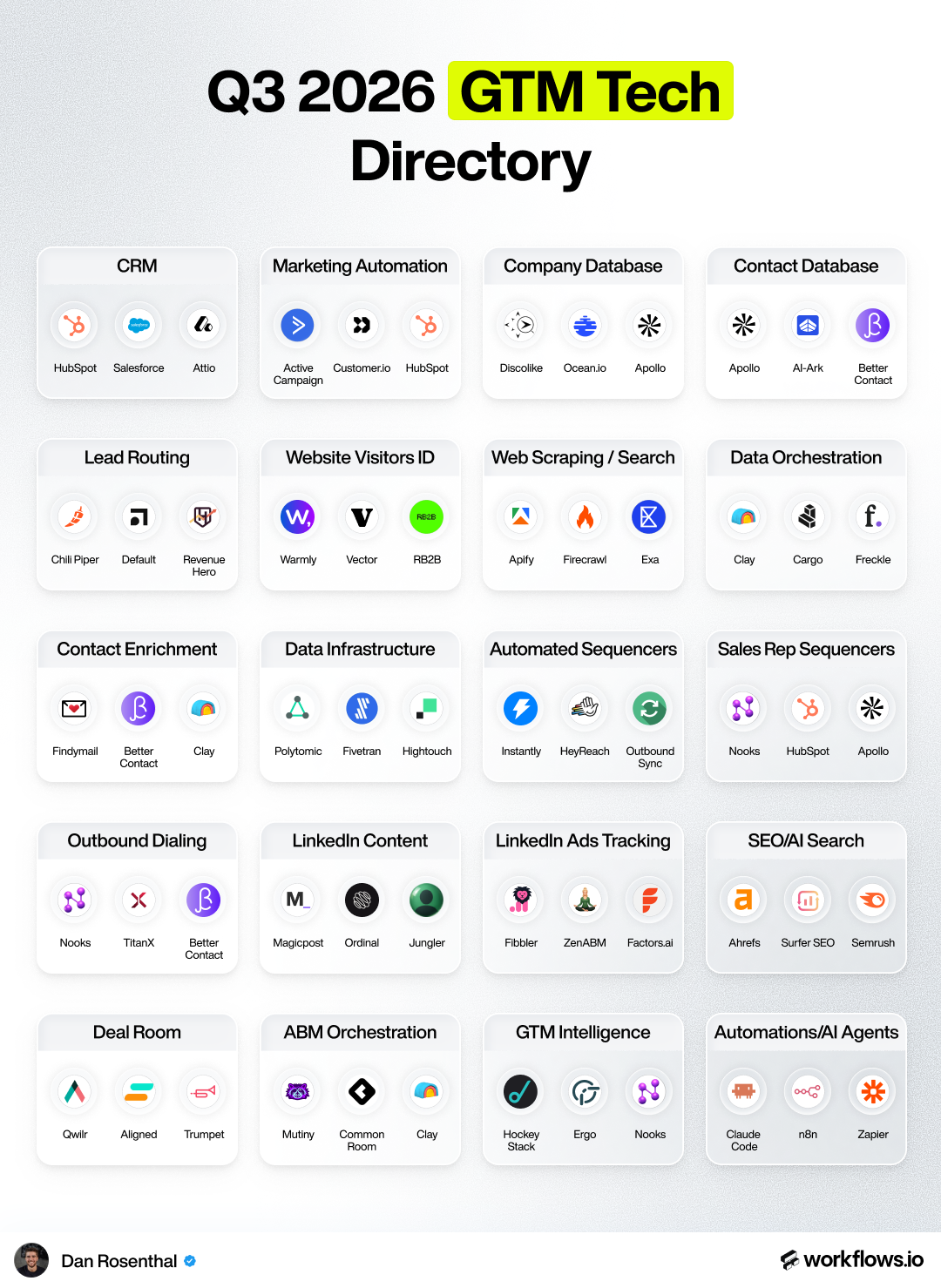
Company database. Where your target account list starts. DiscoLike for niche lookalikes, Ocean.io for tight B2B SaaS lists, Apollo for broadest coverage.
Contact database. Where the people inside those accounts get sourced. Apollo, AI Ark, BetterContact.
Enrichment. Where verified emails, phones, and job history get attached to each contact. Findymail, BetterContact, Clay.
Data infrastructure. Where the data lives, cleans, and moves. Polytomic, Fivetran, Hightouch.
Layer 2: The execution layer
The execution layer is where the touchpoints happen. Emails go out, ads run, meetings get booked, deals close.
The eight categories that live here:
CRM: HubSpot, Salesforce, Attio.
Marketing automation: ActiveCampaign, Customer.io, HubSpot.
Sales rep sequencers: Nooks, HubSpot, Apollo.
Outbound dialing: Nooks, TitanX, BetterContact.
Lead routing: Chili Piper, Default, RevenueHero.
Deal room: Qwilr, Aligned, Trumpet.
LinkedIn content and ads: MagicPost, Ordinal, Jungler for content. Fibbler, ZenABM, Factors.ai for ads.
The execution layer is the layer most teams over-invest in. Buying another sequencer or another dialer is easy to justify, and the vendors are aggressive.
Layer 3: The intelligence layer
The intelligence layer is the newest, the fastest-growing, and the one where 2026 winners over-invest.
The categories that live here:
Data orchestration: Clay, Cargo, Freckle.io.
Website visitor ID: Warmly, Vector, RB2B.
Web scraping and search: Apify, Firecrawl, Exa.
ABM orchestration: Mutiny, Common Room, Clay.
GTM intelligence and attribution: HockeyStack, Ergo, Nooks.
AI agents: Claude Code, n8n, Zapier.
The intelligence layer sits on top of the first two and turns them into a system. It captures signals from anywhere, routes them to the right rep, orchestrates enrichment across data sources, attributes revenue back to the touchpoint that started the deal, and runs autonomous agents on the workflow around it.
Frequently asked questions
What is a GTM stack framework?
A GTM stack framework is a way to organise your sales and marketing tools by the job they do, not the category they sit in. The framework workflows.io uses splits every tool into a data layer, an execution layer, or an intelligence layer.
Why organise by layer instead of by category?
Categories describe what a tool is. Layers describe what a tool does in your business. Two tools in different categories can still overlap in the job they do (e.g., Clay and Common Room both enrich accounts), and the layer view surfaces that overlap immediately.
What ratio of tools should each layer have?
A healthy B2B GTM stack has roughly 3 data-layer tools, 5 execution-layer tools, and 3 intelligence-layer tools. Total 11 core tools, with additional tools inside specific categories depending on team size and ICP.
Where does Clay sit in the framework?
Clay spans data and intelligence. The enrichment work is data-layer, and the orchestration and signal-routing work is intelligence-layer. Most teams count Clay as intelligence because the orchestration is the higher-leverage job.
How do I know if my intelligence layer is weak?
Pick a closed-won deal from the last 90 days and trace it back to the first signal. If it takes longer than 10 minutes, or if you can't do it at all, the intelligence layer is missing pieces.
Should a small team invest in the intelligence layer?
Yes. The intelligence layer used to require a full RevOps team, but modern tools (Clay, Claude Code, HockeyStack) have cut the requirements to one GTM engineer plus an agent stack. A five-person B2B team can build a working intelligence layer today.
What's the biggest mistake teams make with GTM stacks?
Over-investing in the execution layer. Buying a second sequencer or a third dialer is easy to justify, but a thin data or intelligence layer is what actually caps pipeline. Teams often solve for the wrong problem when adding tools.
How often should I audit the stack against the framework?
Once a quarter. GTM tools change fast, and a stack that was well-balanced three quarters ago is usually leaking pipeline today.
Conclusion
The 20 categories that make up a modern GTM stack aren't independent. Every category rolls up to one of three jobs, and the teams that win in 2026 are the ones that see the layers clearly.
A great GTM stack isn't the biggest one, it's the most balanced one. Every layer has strength, no layer has overlap, and the tools coordinate through a shared intelligence layer that turns the whole system into something that compounds.
If you want help auditing your current stack against this framework, book a strategy call with us. We'll walk through the layer-by-layer audit and tell you where the leverage is for your next 90 days.