

According to Forrester, a typical B2B deal in 2026 gets decided by 13 internal stakeholders and 9 outside influencers. That's 22 people making the call, and no single LinkedIn account can reach all of them.
We're a 20-person GTM engineering org at workflows.io, and our team has 150k+ combined LinkedIn followers.
Together, we book 80+ meetings a month from LinkedIn alone.
The reason we can do that is employee-led content. The whole team posts on LinkedIn, and each person covers a different slice of the buying committee we sell into.
This post is the exact strategy we run.
Why employee-led content works
Personal LinkedIn pages get 5 to 8 times more engagement than company pages, which is the platform reality of LinkedIn in 2026.
The math is simple: a company page with 50k followers might reach 500 people per post, while a personal page with 10k followers regularly reaches 3,000+.
When 20 people on your team each publish personal content, the reach multiplies, and when each person covers a different slice of your buyer's world, the whole committee sees you.
That's the shift: one profile chases attention, while a team of profiles surrounds it.
The 5-stage employee-led content playbook
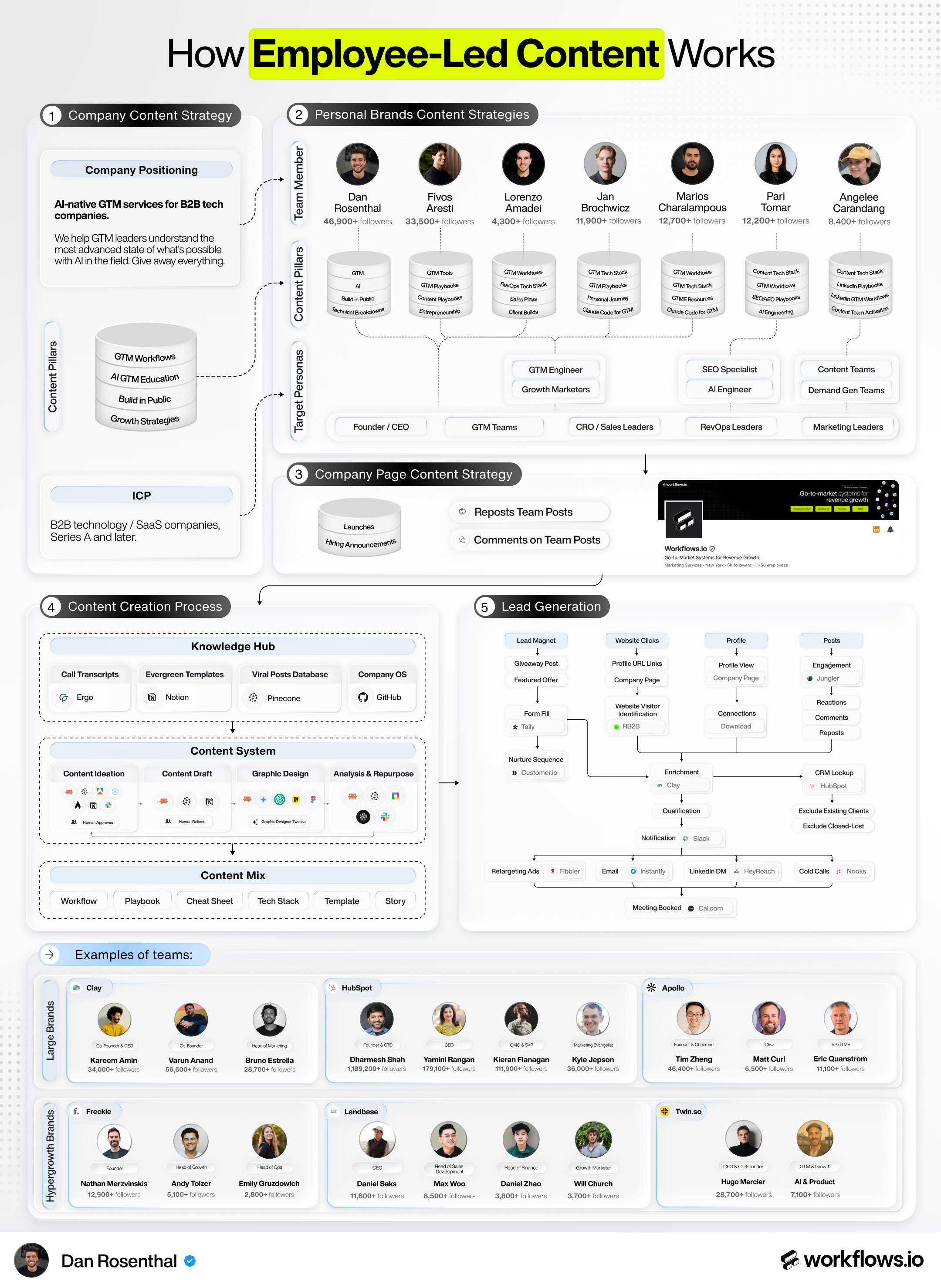
Stage 1: Company content strategy
Everything starts with a shared company strategy that every team member customises for their own audience.
The company strategy at workflows.io has three parts:
Positioning: We help GTM professionals understand the most advanced state of what's possible with AI in the field.
ICP: B2B tech companies, Series A and later.
Content pillars: GTM workflows, AI GTM education, build in public, growth strategies.
Every team member picks their own lane inside these pillars. The strategy is shared, the voice stays personal.
Stage 2: Personal brand strategy
We sell into four or more departments and work directly with end-users, champions, and decision-makers. The content that lands with each of them vastly differs, so every team member owns three to four content pillars of their own.
Here's how it splits across the team:
Dan and Fivos cover GTM, AI, technical breakdowns, and building in public.
Marios and Jan make it more practical with hands-on GTM plays.
Pari is a developer and puts a technical spin on everything, aimed at developer-leaning teams.
Angelee is our Content Lead and writes for other content teams.
Stage 3: Company page
Personal pages get 5 to 8 times more engagement than company pages. Until we hit 50k company followers, we don't try to compete with the personal pages on our own team.
Instead, we use the company page for three things:
Hiring: Every open role gets a company page post.
Reposting: Every team post gets reposted for extra distribution.
Engagement: The company page engages with the team's posts and anyone mentioning us.
Many personal brands equal one strong company brand.
Stage 4: Content creation
Nobody starts from a blank page.
The whole team has a shared knowledge hub that removes the blockers:
Evergreen templates in Notion: every post format we use lives in a template.
Call transcripts in one central repo: every customer call and internal debate stored in Ergo.
Company OS in GitHub: reusable content creation skills anyone can pull into Claude Code.
Unlimited designer access: every team member has design support for graphics and carousels.
Pinecone vector database: every workflows.io post plus 2,000+ curated viral posts stored for RAG retrieval.
On top of that, we run a quarterly LinkedIn competition with cash prizes for top posts, engagement, and follower growth. It keeps the team motivated when writing gets hard.
Stage 5: Content conversion
Every team member's posting effort feeds into one shared conversion funnel.
The five layers of the funnel:
Capture: Connections, engagement via Jungler, website visits via RB2B and Apollo, lead magnets via Tally.
Enrich and qualify: Every lead runs through Clay with a custom qualification agent.
Cross-check: HubSpot lookups exclude existing clients and closed-lost accounts.
Retarget: Instantly for email, HeyReach for LinkedIn DMs, Nooks for calls, and LinkedIn ads for the rest.
Book: Meetings booked through Cal.com.
Everyone's post feeds the same pipeline, so a commenter on Dan's post might book a call with Fivos, and a follower of Marios might download Angelee's lead magnet. The whole funnel compounds.
Frequently asked questions
What is employee-led content?
Employee-led content is a GTM strategy where every employee at a company publishes content on their personal profile, coordinated around a shared company strategy but customised to their own voice and audience. The result is broader reach and better coverage of the buying committee than a single company page can deliver.
Why is employee-led content more effective than company page content?
Personal LinkedIn profiles get 5 to 8 times more engagement than company pages. A team of 20 personal profiles reaches significantly more people than the company page alone, and each profile can cover a different slice of the buying committee.
How many employees does it take to run this strategy?
The strategy starts working with three to four regular posters who each cover a different content pillar, and it compounds after 10+ team members are actively posting.
How does employee-led content convert into meetings?
Content generates signals (post engagement, connection requests, website visits, lead magnet downloads) that get captured, enriched, and routed into a retargeting layer of email, LinkedIn DMs, cold calls, and ads. Meetings get booked through Cal.com at the end of the funnel.
What tools do I need to run employee-led content?
The core stack includes Notion (templates), GitHub (Company OS), Pinecone (post RAG), Jungler (post engagement capture), RB2B and Apollo (website visitor identification), Clay (enrichment), HubSpot (CRM), Instantly and HeyReach (retargeting), and Cal.com (booking).
What's the difference between employee-led content and founder-led content?
Founder-led content is one person (usually the founder) posting to build a personal brand. Employee-led content is the whole team posting, each covering a different content pillar and buyer persona. Employee-led scales further because it covers the full buying committee, not just the founder's angle.
Conclusion
The best B2B content in 2026 doesn't come from a single voice, it comes from a whole team, with each person publishing in their own voice and covering a different corner of the buying committee.
Building this takes more work than a founder-led playbook, but once it's running, it compounds in a way one profile can't match.
If you want help building it for your team, book a strategy call with us. We'll walk through what content pillars your team should own, what tools to layer in, and what the first 90 days look like.