

A B2B growth engine runs on seven stages. The order matters, and the handoffs between them are where most teams lose the most pipeline.
We're a 20-person GTM engineering org at workflows.io, and this is the exact blueprint we use to map out funnels for our clients.
Seven stages, from the first impression to the closed-won deal that turns into an expansion opportunity twelve months later.
Each stage has its own tooling, its own metrics, and its own failure modes. When it's set up right, the funnel starts running like a flywheel.
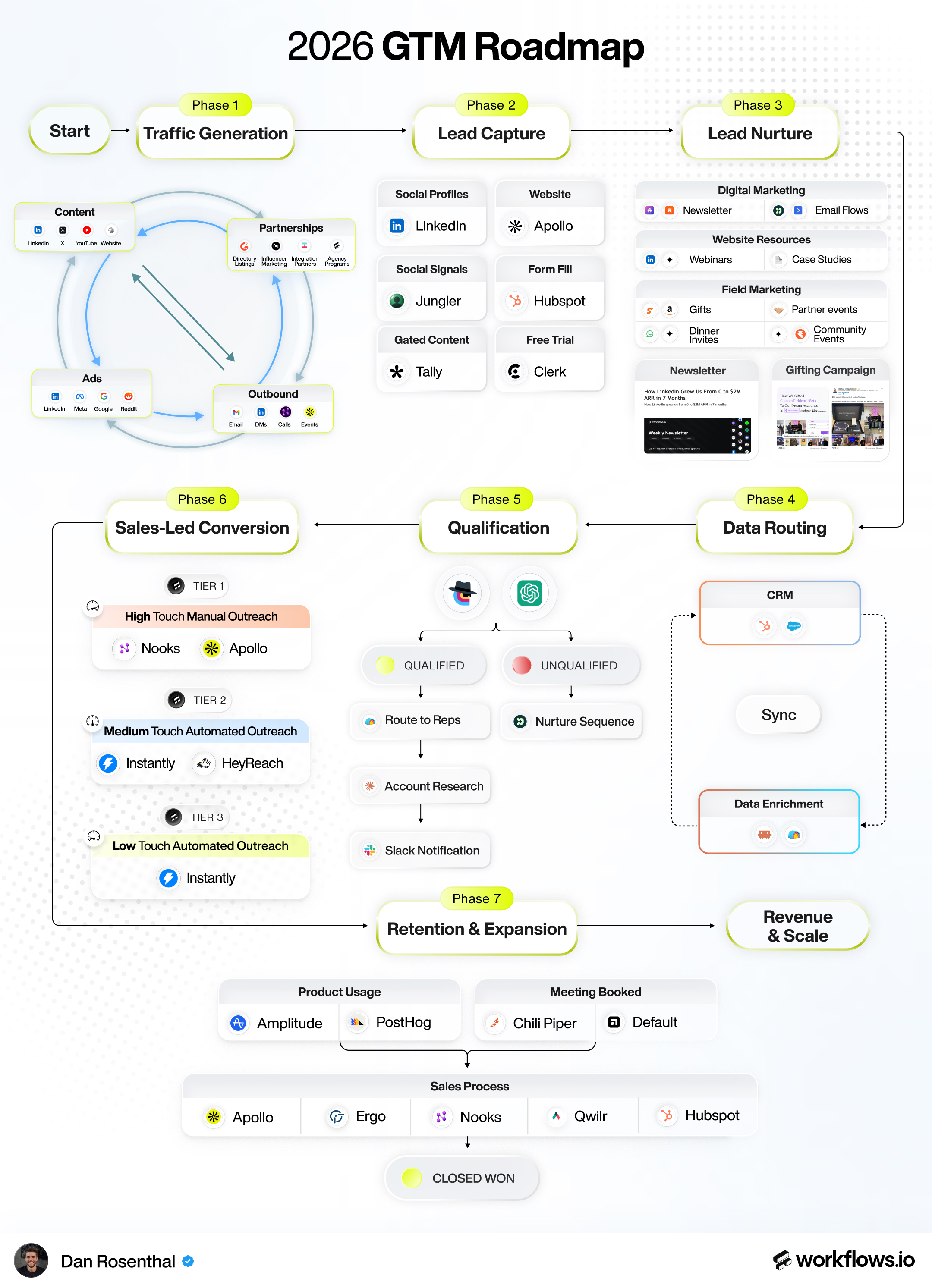
The 2026 GTM roadmap
Stage 1: Traffic generation
Attention comes first.
The teams that scale run at least two traffic channels in parallel so no single algorithm change or channel constraint takes the whole system down.
Four categories to pick from:
Outbound: Email, LinkedIn DMs, cold calls, events.
Content: LinkedIn, X, YouTube, website.
Ads: LinkedIn, Meta, Google, Reddit.
Partnerships: Directories, influencers, integrations, agency programs.
Stage 2: Lead capture
Traffic is worth nothing until a name is attached to it. Six ways to convert impressions into captured leads:
Social followers on LinkedIn.
Website visitors identified through Apollo.
Social signals captured through Jungler.
Gated content filled out through Tally.
Form fills collected in HubSpot.
Free trials activated through Clerk.
Stage 3: Lead nurture
Not every lead is ready to buy the day they land. Nurture is the layer that turns awareness into trust over weeks and months.
Three avenues do the work:
Digital marketing: Newsletter, email flows, retargeting, organic social.
Website resources: Case studies, demos, free tools, webinars.
Field marketing: Gifts, dinners, partner events, community events.
The best programs run all three in parallel, sequenced against each account's stage in the buying cycle.
Stage 4: Data routing
Leads and touchpoints should sync to the CRM automatically, with enrichment applied on the way in.
Tools that handle this at scale:
Without a data routing layer, your funnel breaks at the first handoff. Reps ignore leads, marketing double-touches, and attribution turns into guesswork.
Stage 5: Qualification
Leads get automatically scored into Tier 1, Tier 2, or Tier 3.
The routing rules:
Qualified leads get enrolled in sequences, routed to reps, and pinged in Slack.
Unqualified leads get moved into a nurture sequence.
Scoring methodology is the piece that powers everything downstream, so getting it right is a must. Get it wrong and your reps chase the wrong accounts while your best leads sit untouched.
Stage 6: Sales-led conversion
Match effort to account potential. The three tiers each get a different level of touch.
Tier 1: high-touch manual. Reps use Nooks and Apollo to build 1:1 relationships with your dream accounts.
Tier 2: medium-touch automated. Instantly and HeyReach run coordinated sequences with lighter personalisation.
Tier 3: low-touch automated. Instantly runs bulk sequences with volume targeting.
The mistake most teams make is applying the same touch to every tier. Tier 1 accounts deserve 10x the effort of Tier 3, and the tooling should reflect that.
Stage 7: Close, retention, and expansion
The funnel doesn't end at closed-won. Four pipelines run in parallel from that point forward: leads, deals, renewals, and expansion.
Tools to layer in for each step:
Product usage: Amplitude and PostHog track how customers actually use the product.
Meeting routing: Chili Piper and Default route inbound demos to the right rep instantly.
Sales process: Apollo, Ergo, Nooks, Qwilr, and HubSpot manage the full deal cycle from first touch to signature.
Retention and expansion are where the compounding math starts to work. Customers who stay a year become the base of your next year's revenue.
When the funnel becomes a flywheel
Done right, the seven stages stop looking like a linear funnel and start looking like a compounding system.
Outbound chases the hand-raisers from your content. The people who engaged with a LinkedIn post yesterday get a personalised email today.
Your best content becomes your ads. The post that pulled 100k impressions organically gets a $5k boost and does another 500k.
Your ads hit the same accounts as your outreach. The prospect sees your founder's face in their feed on Monday, gets a cold DM on Tuesday, and books a meeting on Wednesday.
That's when exponential growth happens.
Frequently asked questions
What is a GTM roadmap?
A GTM (go-to-market) roadmap is a stage-by-stage blueprint for how a company generates traffic, captures leads, nurtures them, routes data, qualifies opportunities, converts deals, and retains customers.
How many traffic channels should a B2B company run?
At minimum two, ideally three or four. Running one channel means you're at the mercy of that channel's algorithm, competition, or platform changes.
What is lead scoring?
Lead scoring is the process of automatically ranking leads into tiers based on ICP fit, buying signals, and engagement. The output determines who gets routed to a rep and who goes into nurture.
What tools do I need to run this GTM roadmap?
The core stack includes HubSpot or Salesforce as the CRM, Clay for data routing, Apollo for outbound and enrichment, Instantly and HeyReach for automated sequences, and a product analytics tool like Amplitude or PostHog for the retention layer.
What's the difference between a funnel and a flywheel?
A funnel is linear: leads enter at the top, deals close at the bottom, and the process starts over. A flywheel is circular: each stage feeds and compounds the others, so growth accelerates instead of restarting.
Which stage of the GTM roadmap breaks first?
Stage 4 (data routing) is the most common breakage point. When leads don't sync to the CRM automatically, reps miss timing windows, marketing double-touches, and attribution falls apart.
Conclusion
A lot of B2B teams treat GTM as a set of disconnected campaigns. Traffic runs in one system, leads sit in another, and sales works out of a third.
The teams that grow the fastest treat GTM as one system. Every stage feeds the next, every tool talks to every other tool, and every lead moves through a coordinated sequence from first impression to expansion.
At workflows.io, this is the roadmap we build for every client we onboard.
If you want help mapping this out for your business, book a strategy call with our team. We'll walk through where you are today, which stages are broken, and what it would take to build the full system.