

LinkedIn ads campaigns fail in one of three ways:
You burn through budget on broad targeting that hits the wrong people.
You get cheap clicks from a low-intent audience that never converts.
You see beautiful CTRs in Campaign Manager but zero pipeline in HubSpot.
The frustrating part is that LinkedIn is the highest-intent B2B platform in existence. Your buyers are on it every day, reading posts, watching videos, scrolling through ads.
What goes wrong is the strategy.
A lot of teams treat LinkedIn ads as a standalone channel: throw budget at a campaign, hope leads come in, declare it broken when they don't.
LinkedIn ads work when they don't work alone. They work as the priming layer underneath everything else: outbound, content, demo requests, sales calls.
The accounts your team is reaching out to are also seeing your founder's face in their feed. That's the engine this playbook builds.
When LinkedIn ads make sense
Before any of this, three conditions need to be true.
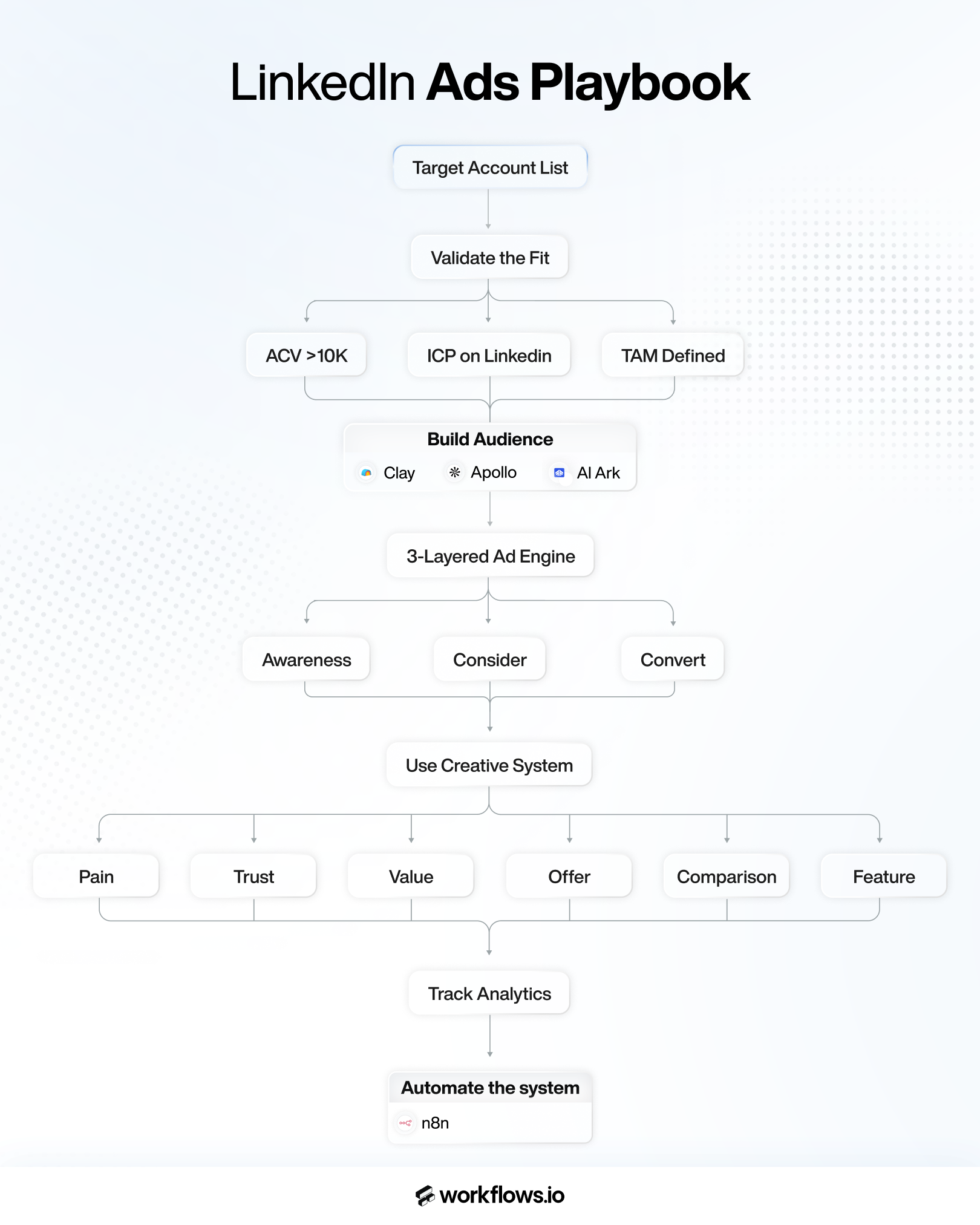
Your ACV is above $10,000
LinkedIn CPMs (cost per 1,000 impressions) run $30 to $80, which means your cost per lead lands at $200 to $500. Smaller deal sizes don't absorb that.
Your ICP (ideal customer profile) is on LinkedIn
C-level, VP, and Director roles at B2B companies are. Developers and ICs (individual contributors) usually aren't.
You have a defined TAM (total addressable market)
A target account list of 200 to 500+ companies. Broad LinkedIn targeting burns budget fast.
If you have all three, this guide is for you.
What to expect
A few benchmarks for the system once it's running:
LinkedIn CPMs: $30-80 (matched audiences trend higher)
Good CTR (click-through rate) on matched audiences: 0.5-1.2%
Cost per lead gen form fill: $50-250
Cost per website click: $3-8
Time to first qualified demo: 6-12 weeks
Retargeted audiences convert 40-60% cheaper than cold
The three layers of Linkedin ads engine
Layer 1: Awareness
This is where you prime the account before anyone on your team reaches out.
You're running founder content boosts and short-form videos to your target list. Nothing is asking the prospect to do anything. You're just buying recognition.
The trick is that nothing converts directly from awareness. You're not measuring leads here. You're building the audience pool that retargeting then converts.
By week four, your founder has been in their feed five to ten times. Now your SDR can reach out.
Layer 2: Consideration
This is where you start showing them something more substantive.
Gated PDFs, case studies, articles about their problem. The action you're asking for is small: download a guide, read a piece, engage with content.
In parallel, your team is sending LinkedIn connection requests to the same list. The prospect accepts because the name is familiar from four weeks of awareness ads.
The retargeting pools are filling up. Article visitors, PDF downloaders, form openers who didn't submit. All of them become the audience for layer three.
Layer 3: Conversion
This is where the asks get direct.
Lead gen form ads with pre-filled forms. "Book a demo" landing pages. Offer-focused creative: free assessment, ROI calculator, audit.
Your sales team is sending DMs and emails to the same accounts. The DM references the value prop the prospect saw in the ad. The email mentions a case study they downloaded last week.
Reply rates on outbound to ad-primed accounts run 1.5 to 2x higher than cold. That's the compounding effect.
The audience question
The audience is everything.
Four ways to build it, in order of effectiveness.
Upload your outbound list as a matched audience
This is the best option if you already run outbound. Export contacts from Clay, Apollo, or your CRM, and aim for 500+ contacts.
LinkedIn typically matches 60 to 80 percent of clean data. If your match rate is below 50 percent, your email data is bad and you need to re-enrich before anything else.
Upload a company list and layer on role filters
Works for small TAMs of 200-500 companies. You get broader reach within each account, hitting roles you don't have contacts for.
Use LinkedIn's native targeting
Only for larger TAMs of 1,000+ companies. Less precise but reaches accounts you haven't identified yet. Always exclude current customers and competitors.
Build the audience in Clay using signals LinkedIn can't see
Tech stack ("companies using Stripe"), funding stage ("Series A in last 12 months"), hiring signals, or intent data from RB2B or Albacross. Export from Clay and upload as a matched audience.
Creative that actually works
Every ad set gets 3-4 creatives. Each one tests a different angle.
The six angles that consistently produce something:
Pain: Names the problem they feel every day.
Value: Shows the outcome they want.
Trust: Social proof from recognisable names.
Offer: Leads with the CTA.
Comparison: Positions against the alternative.
Feature: Shows the product UI.
The retargeting engine
Ad campaigns run as a flat funnel.
People see the ad, they convert or they don't. The fall-off is brutal. Retargeting fixes the fall-off.
The flows we run:
Awareness → Consideration: People who watched 25%+ of your video ads, or engaged with boosted thought leadership posts.
Awareness → Conversion (skip consideration): People who watched 50%+ of video ads. Test direct conversion for these.
Consideration → Conversion: People who clicked through to articles, downloaded gated content, or opened a lead gen form without submitting.
Conversion → Hard retargeting: Form openers who didn't submit get hit with urgency or social proof creative. Pricing page visitors who didn't convert get the same treatment.
Budget reality
The minimums:
$3K/month runs consideration and conversion only. Skip awareness. Works for TAMs under 500 accounts.
$5K/month runs all three layers. Recommended for the full system.
$10K+/month runs the full system with creative testing velocity. Four+ creatives per ad set, weekly optimisation.
The split, once you're at $5K+:
Awareness: 10-15% of budget. Cheap impressions, builds the foundation.
Consideration: 20-30%. Drives engagement, feeds retargeting pools.
Conversion: 55-70%. Where pipeline comes from.
The tests we run every month: manual bid vs. maximum delivery, lead gen forms vs. landing pages, different offers (assessment vs. demo vs. guide), different angles (pain vs. value vs. trust), different audience compositions.
Lead gen forms beat landing pages 80 percent of the time. Test anyway, because some products are the exception.
Conclusion
A lot of teams treat LinkedIn ads like Facebook ads for business. Pick an audience, write some copy, watch the metrics.
That frame is dead.
LinkedIn ads are the priming layer for everything else you do in B2B. The lift doesn't come from the ads themselves. It comes from running ads in lockstep with your outbound, your content, and your CRM signals.
When you wire it up right, the same prospect sees your founder's post, then your case study, then your SDR's connection request, then your AE's email, all inside six weeks. By the time someone asks for a call, they already trust the name on the calendar invite.
That's what the playbook is buying you.