

Every B2B company runs at least one GTM motion. The ones that grow fastest run four or five in parallel, coordinated end-to-end.
Some produce pipeline in a week, others compound over years, a few scale without adding headcount, and others need a full team to make work.
We've overseen the GTM motions of 250+ B2B companies at workflows.io. Here are all nine, with the workflow behind each one from ICP model through to closed-won.
What is a GTM motion?
A GTM (go-to-market) motion is a repeatable system for generating pipeline and revenue.
A motion is the whole system around that channel: ICP model, list, sequencing, routing, follow-up, and closing.
The nine motions below each combine multiple channels into a coherent system, and what follows is how each one actually runs, from ICP model through to closed-won.
1. Automated Outbound
Automated outbound puts hundreds of ICP-fit accounts through coordinated multi-channel sequences every week.
Cold outbound is one of the most effective B2B channels, and the workflow that makes it work runs in five stages.
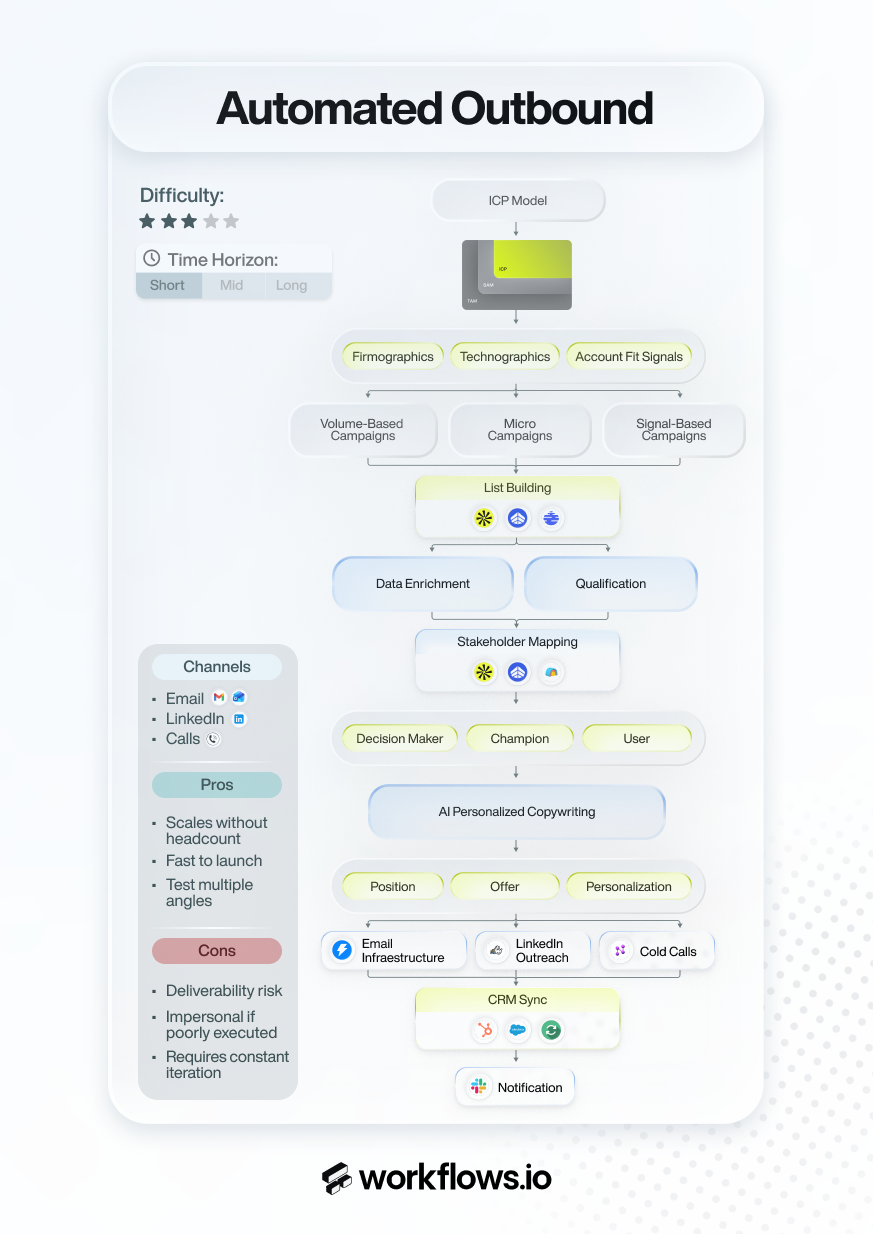
Stage 1: ICP model and campaign strategy
You start by defining who you're going after. That means mapping every segment across three dimensions:
Firmographics: Industry, company size, geography, revenue.
Technographics: The tools they already use, which tells you what fits alongside your product.
Account fit signals: Recent hires, funding rounds, tech stack shifts, product launches.
Then you pick a campaign type.
Volume campaigns target broad ICP audiences with lighter personalisation.
Micro-campaigns hit narrow segments with tight personalisation.
Signal-based campaigns fire only when a specific trigger goes off at an account.
From there, you pick the plays you want to run. Some examples:
Website visitor retargeting
Ad engagement follow-up
Closed-lost reopens
The plays you choose dictate the tools you need to buy.
Stage 2: Account sourcing and stakeholder mapping
There are three ways to build your list.
Scraping: Apify, Serper, custom Python scrapers.
Every source routes into Clay, which becomes the central control layer.
Inside Clay, you dedupe and normalise the data, then qualify each company with a custom ChatGPT agent. Once companies are qualified, Findymail and BetterContact find verified emails and phone numbers for the right contacts by checking multiple data providers in sequence.
Stakeholder mapping identifies three roles per account: decision makers, champions, and users. Each one gets a slightly different message because each one cares about different things.
Stage 3: Copywriting
Every outbound message has three pillars.
Positioning: Why you, why now.
Offer: What's in it for them.
Personalisation: Make it specific to the account and the moment.
Each sequence has multiple versions per segment. The standard is four variants at each step, with the data picking the winner.
LinkedIn messages should be shorter and more conversational than email, which can carry more copy.
Stage 4: Campaign execution
Two tools do the work.
Send limits matter more than most teams realise. Deliverability is everything.
Email: 15 sends per day per mailbox.
LinkedIn: 20 DMs per day per account.
Reverse-engineer the numbers. If you need to reach 1,000 contacts a week via email, that's 143 sends a day, which means around 10 mailboxes.
Same math for LinkedIn.
Stage 5: CRM sync and reporting
Every activity logs back to the CRM.
OutboundSync sits between Instantly, HeyReach, and your CRM, pushing every open, click, and reply into a single place. That gives you clean reporting across both channels.
Nooks auto-creates call tasks for reps whenever a positive reply comes in. Slack notifications fire on positive replies too, with phone number data attached via BetterContact so the rep can call immediately.
The team it takes to run this
The whole motion can run with one GTM engineer and one sales rep.
Even if you're not ready to hire a full outbound team, this is the version of the motion you should have running.
2. Product-Led Growth (PLG)
Product-led growth is the motion where the product does most of the selling.
The whole system runs on data. Every user action becomes a signal, every signal feeds a workflow, and the workflow decides when a human gets involved.
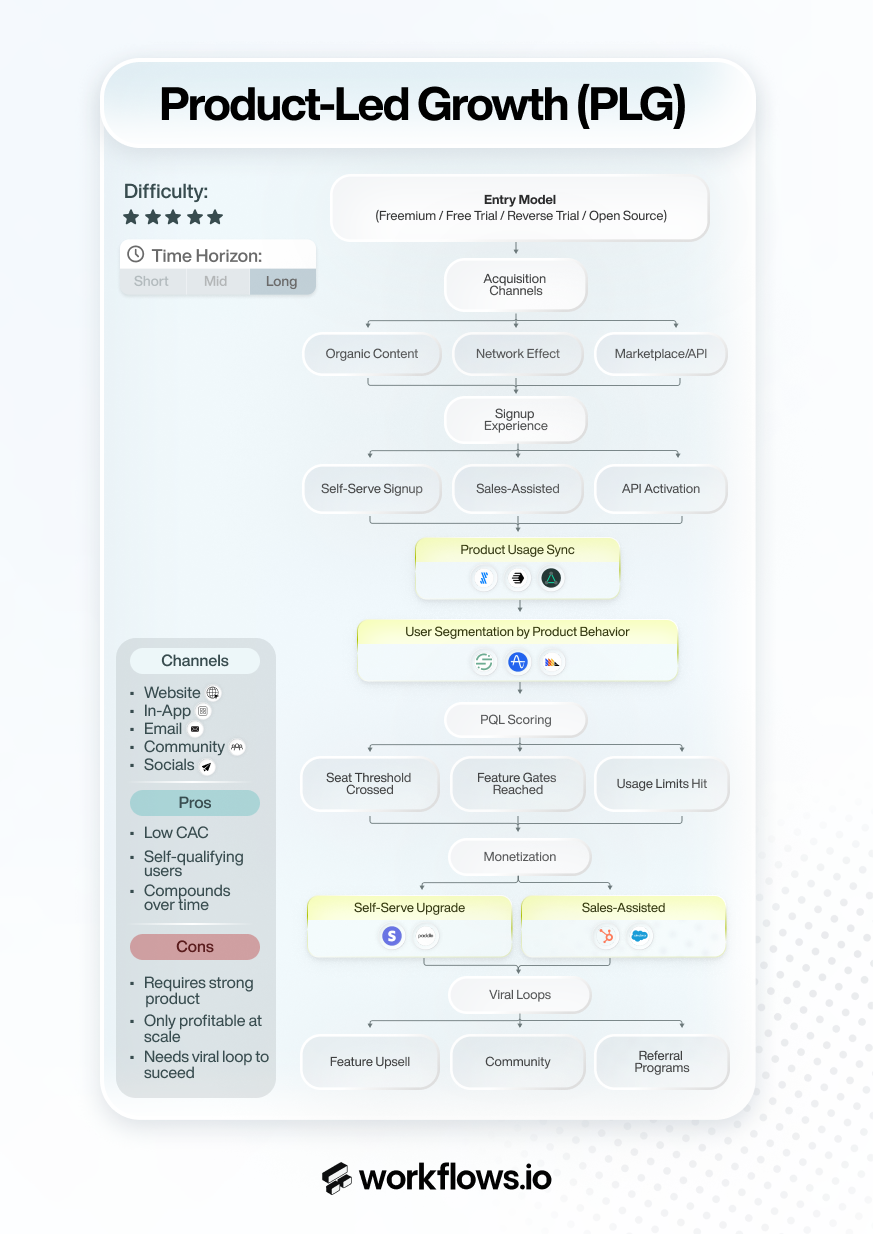
Stage 1: Entry model and acquisition
You start by picking how users first touch the product.
Freemium: Users get free access forever with paid upgrades.
Free trial: Users get a time-boxed premium experience.
Reverse trial: Users start with premium and downgrade to free after the trial.
Open source: Users self-host with paid features on top.
Each model has a different economics profile: freemium optimises for reach, reverse trial optimises for showing value fast, and open source optimises for developer trust.
Acquisition runs through three channels.
Organic content: SEO, YouTube, LinkedIn.
Network effects: Referrals, shared workspaces, embeds.
Marketplace and API listings: Putting your product inside adjacent platforms.
Stage 2: Signup experience
The signup experience routes each user into one of three activation paths.
Self-serve signup: They set up on their own. Fastest, lowest CAC.
Sales-assisted: A rep helps them onboard. Higher CAC, higher retention.
API activation: They hit your API before ever seeing your UI. Common in developer tools.
The path you route them into depends on ICP fit, deal size, and complexity.
Stage 3: Product usage sync and segmentation
Product usage syncs back to a data warehouse in near real time.
Tools like Segment, Fivetran, and Amplitude handle the pipeline. Users get segmented by behaviour: power users, dormant users, users approaching a limit, users hitting a feature they don't have access to.
Stage 4: PQL scoring and monetisation
PQL (product-qualified lead) scoring layers on top of usage data.
A user becomes a PQL when they cross one of three lines.
Seat threshold crossed: They added enough users to trigger a plan tier.
Feature gates reached: They tried to use a feature that's behind a paywall.
Usage limits hit: They exceeded a quota (API calls, storage, sends).
These are three of the strongest buying signals a product can generate. When they fire, monetisation kicks in.
Self-serve upgrade: Users click through Stripe or Paddle on their own.
Sales-assisted: A rep runs the deal through HubSpot or Salesforce.
Which path fires depends on deal size. Small deals go self-serve. Large deals go sales-assisted.
Stage 5: Viral loops
Growth in PLG doesn't stop at conversion. Three loops keep the system compounding after users start paying:
Feature upsells: Push existing users into higher tiers.
Community: Keep users engaged between purchases and drive product feedback.
Referral programs: Turn happy users into acquisition.
The best PLG products layer all three so growth compounds instead of relying on paid acquisition.
3. Manual Outbound / Cold Calling
Manual outbound is the motion where reps research and reach out to accounts one at a time.
It looks similar to automated outbound on the surface, but the resource split is inverted. Automated outbound is 90% infrastructure and 10% rep time. Manual outbound is the opposite.
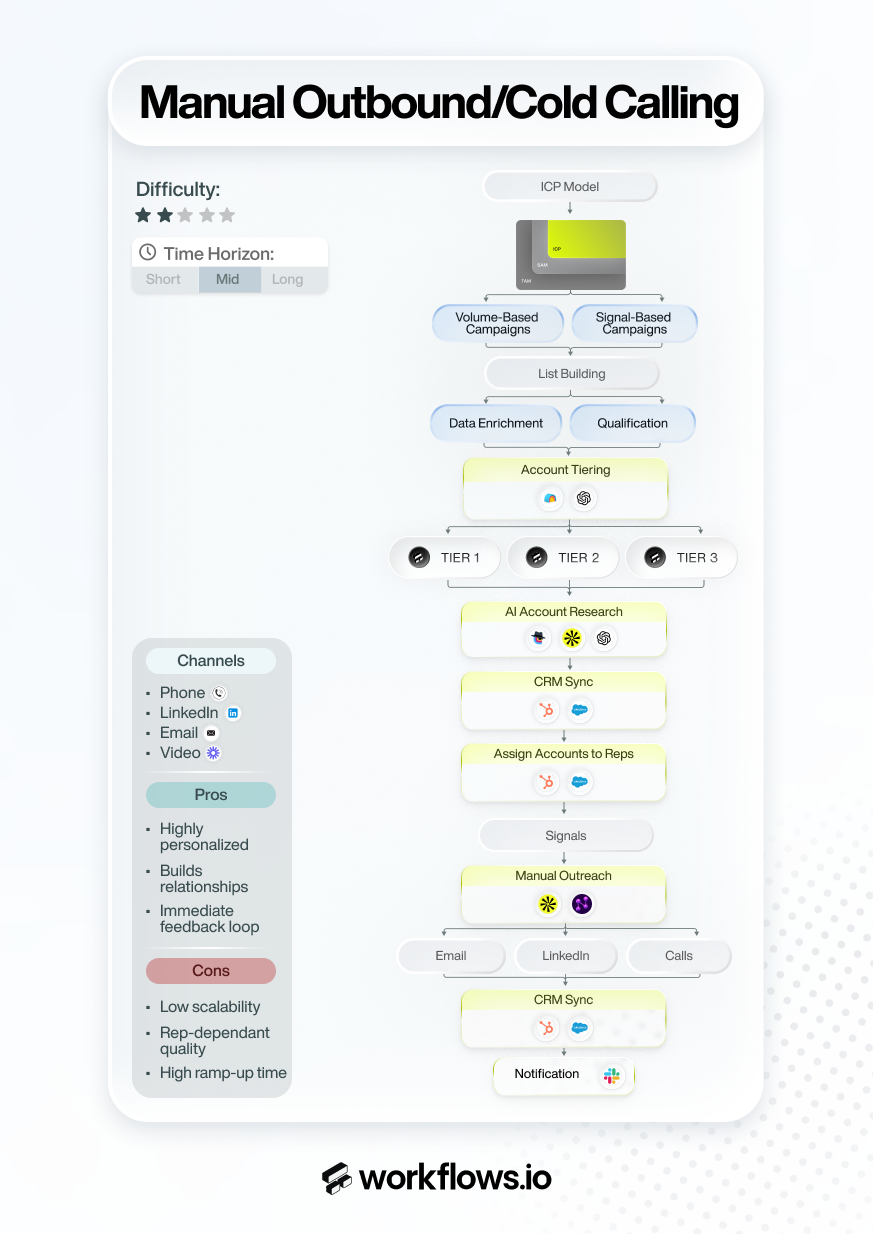
Stage 1: ICP model and campaign strategy
You start with the same ICP model as automated outbound. From there, campaigns split into two categories.
Volume-based: Reps hit a larger list with slightly personalised messages.
Signal-based: Reps hit a shorter list when a specific trigger fires.
List building, data enrichment, and qualification run through the same steps as automated outbound.
Stage 2: Account tiering
The manual motion earns its keep at tiering.
Each account gets scored and placed into one of three tiers.
Tier 1: Dream accounts that get full personalisation and rep-owned outreach end-to-end.
Tier 2: Strong fit with templated personalisation and semi-automated outreach.
Tier 3: Broad fit, automated where possible.
Tier 1 is where manual outbound produces the biggest lift over automated. A cold call to a Tier 1 CFO that references their earnings call is worth 50 automated emails.
Stage 3: AI account research
Before any human touches the account, AI runs the research.
Perplexity, Clay, and ChatGPT pull public signals: news, hiring, funding, tech stack, product launches, executive changes. That research syncs to the CRM as a pre-call brief.
The rep opens the brief and hits the phone already knowing what happened at the account this week.
Stage 4: Rep assignment and outreach
Reps get assigned accounts from their tier. When a signal fires, the rep runs manual outreach across four channels.
Phone: Cold calls dialled through Nooks.
LinkedIn: One-at-a-time DMs and connection requests through Apollo or HeyReach.
Email: Personalised sends through Apollo or HubSpot.
Video: Loom or Vidyard messages for high-priority accounts.
The channel mix depends on the persona: sales leaders answer LinkedIn, RevOps leaders answer email, and CROs answer video.
Stage 5: CRM sync and reporting
Every touch syncs back to the CRM, and every reply triggers a follow-up task.
A Slack notification alerts the team when something moves, and the rep runs the deal from there.
4. ABM (Account-Based Marketing)
ABM is the motion that works backwards from a defined list of dream accounts and coordinates every channel against them.
The whole system is designed around one number: pipeline created in the target account list.
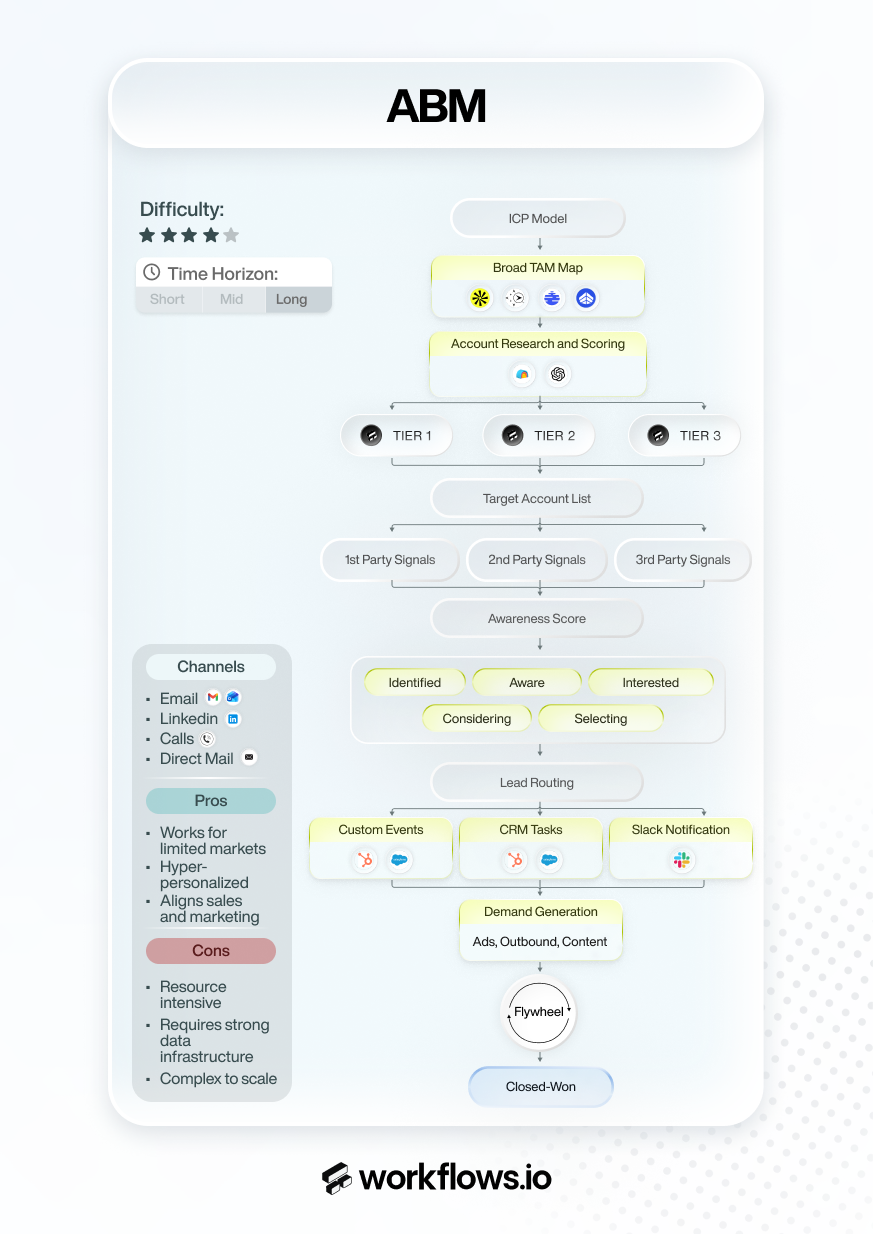
Stage 1: ICP and TAM mapping
You start with an ICP model, then a broad TAM (total addressable market) map. Every company that could theoretically buy from you goes on that list.
TAM sourcing pulls from multiple databases. Clay, Discolike, Ocean.io, and AI Ark cover different slices of the market. Combining them typically hits 90%+ coverage.
Stage 2: Account research and tiering
Once you have the TAM, account research and scoring narrow it down.
Each account gets scored on fit signals: firmographics, technographics, hiring, product signals. Accounts get tiered into Tier 1, Tier 2, and Tier 3 based on ICP fit and revenue potential.
From the scored TAM, you cut down to the target account list. That's the group every motion runs against.
Stage 3: Signal architecture
Signal tracking runs continuously across three categories.
1st party signals: Website visits, product usage, CRM activity.
2nd party signals: Data from external tools you subscribe to (Clay, RB2B, Jungler).
3rd party signals: Public data (news, funding, hiring).
Each signal type feeds into the same awareness engine.
Stage 4: Awareness scoring and lead routing
Awareness scoring rolls signals into account-level stages.
Identified: Part of the qualified target account list, no engagement yet.
Aware: Surface-level engagement. A website visit or 50+ ad impressions.
Interested: Repeated or high-intent engagement.
Considering: Bottom-funnel stage right before the first meeting.
Selecting: Active deal cycle with an opportunity in the CRM.
When an account moves up a stage, the system routes them differently.
Custom events fire into HubSpot or Salesforce.
CRM tasks drop on reps.
Slack notifications ping for the accounts that need immediate attention.
Stage 5: Demand generation flywheel
Demand generation runs on top of the whole system.
Ads target the account list at every stage of awareness.
Outbound hits the buying committee once the account is Aware or higher.
Content nurtures accounts not ready to buy.
The three channels compound together: ads warm the account for outbound, outbound drives content downloads, and content builds pipeline for ads to retarget.
The flywheel ends in closed-won.
Full breakdown in our ABM in 2026 playbook.
5. Community / Partner Led
Community and partner led is the motion where other people (partners, affiliates, community members) sell for you.
You build an ecosystem, and they bring the leads.
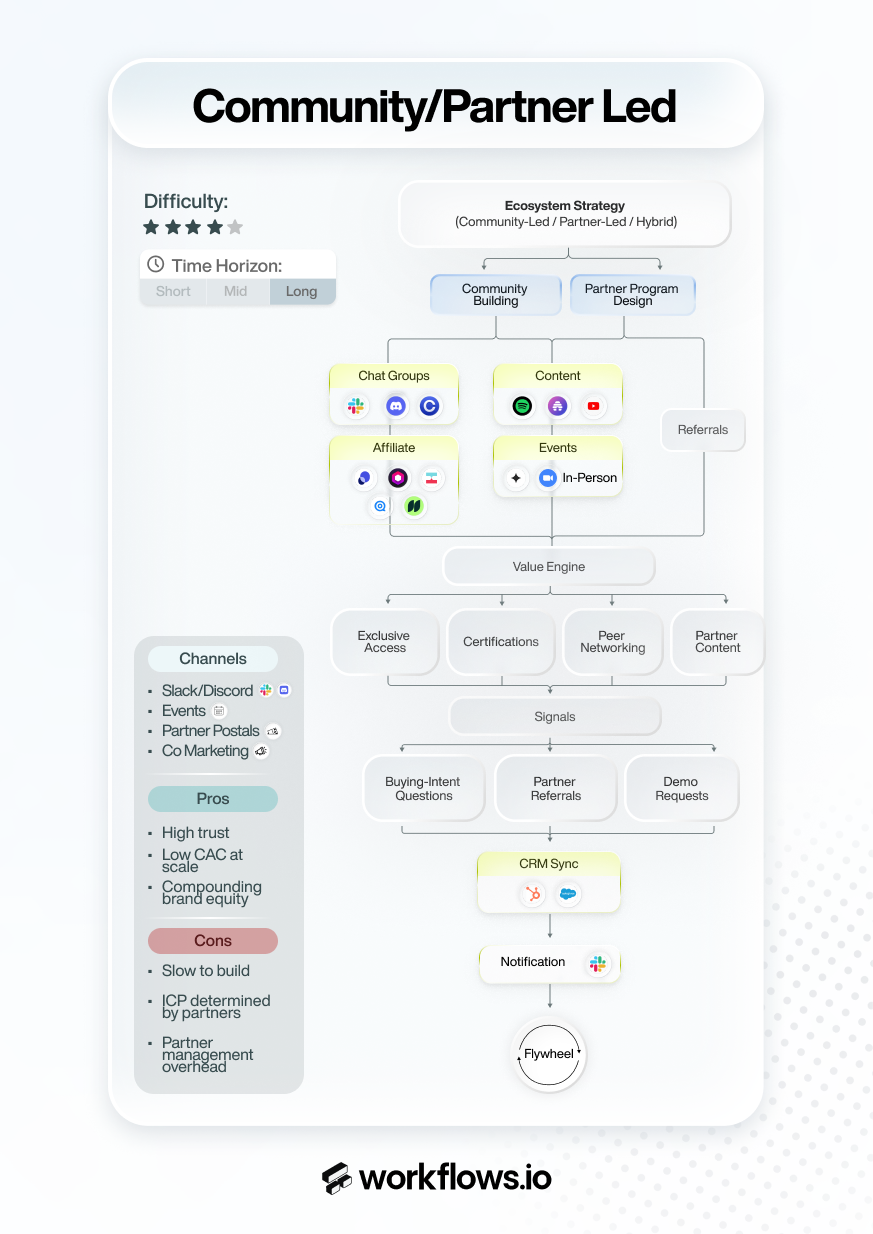
Stage 1: Ecosystem strategy
You start by picking one of three ecosystem models.
Community-led: Your community becomes the acquisition engine.
Partner-led: Partner companies do the selling.
Hybrid: Both, running in parallel.
The choice depends on your buyer: developers prefer communities, enterprises prefer partners, and mid-market often needs both.
Stage 2: Community and partner build
Two parallel builds run from here.
Community building creates the spaces where members gather:
Chat groups (Slack, Discord, Circle)
Content channels (Substack, Spotify, YouTube)
Events (Luma, Zoom, in-person)
Partner program design creates the structure that makes partners want to sell:
Affiliate structure
Referral incentives
Co-marketing motions
Stage 3: Value engine
The value engine gives partners and community members something to rally around.
Exclusive access. To your product, roadmap, or content.
Certifications. That give them credibility in their own market.
Peer networking. Introductions to other members and partners.
Partner content. Co-branded assets they can share.
Without a real value engine, partners and community members stop showing up. This is the piece most teams under-invest in.
Stage 4: Signal capture and routing
Signals fire when the ecosystem produces intent.
A community member asks a buying-intent question.
A partner sends a referral.
Someone in the community requests a demo.
Those signals sync to the CRM. A Slack notification tells the sales team who to reach out to.
Stage 5: Flywheel
The flywheel builds through three loops that reinforce each other.
Customers refer new prospects. Partners bring in new customers. Community content pulls in new members. Each loop feeds the next.
6. Paid Media
Paid media is the motion for buying attention at scale.
Every dollar has to earn its way through the funnel, which means the workflow is tighter than most.
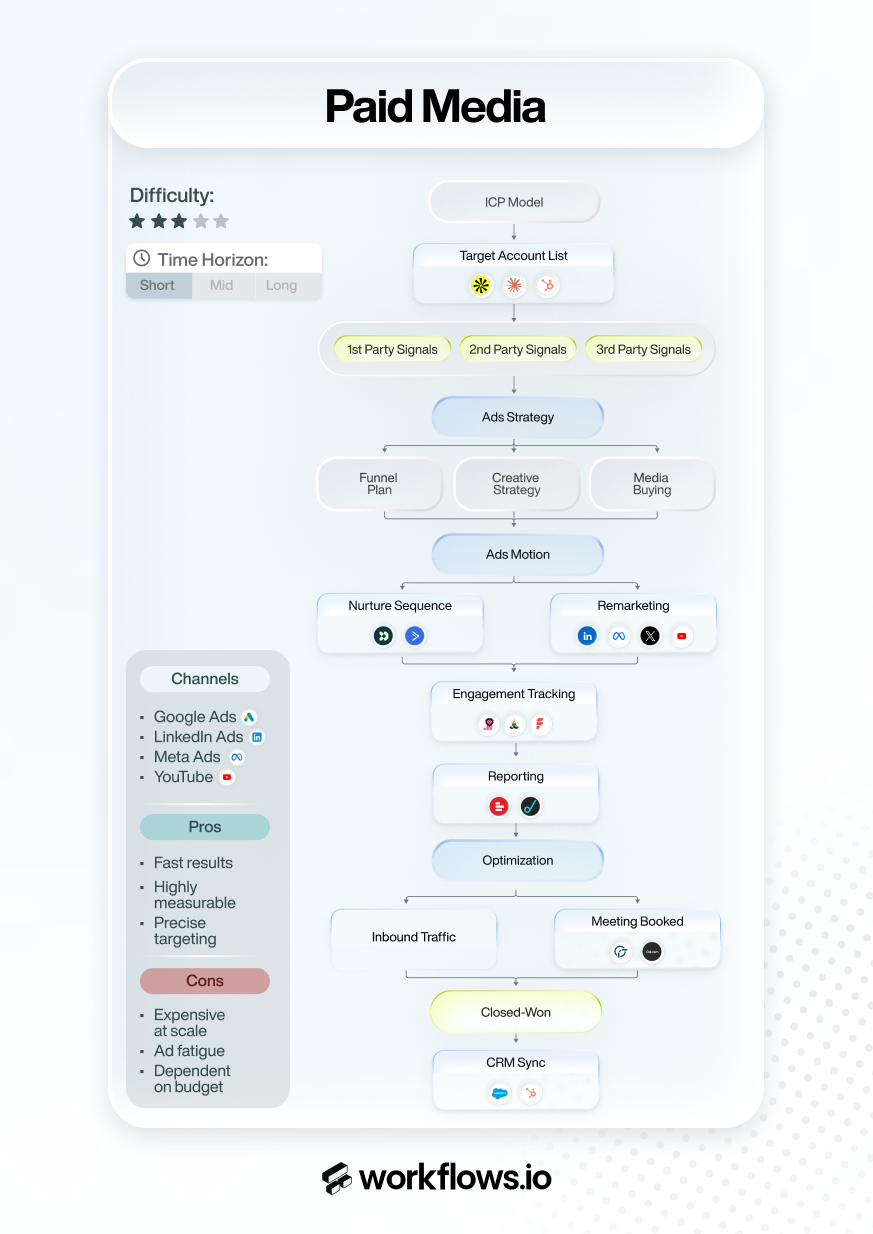
Stage 1: ICP and target account list
You start with an ICP model and a target account list. Signals feed the ads strategy across three categories.
1st party signals: Which accounts are already engaging with you.
2nd party signals: Which accounts are showing intent externally.
3rd party signals: Broader market patterns.
Together, they tell you which accounts to target, which segments to prioritise, and which offers to test.
Stage 2: Ads strategy
The strategy splits into three pieces.
Funnel plan: How ads move users through awareness, consideration, and conversion.
Creative strategy: The visual and message angles you'll test.
Media buying: Which platforms get how much of the budget.
Each piece feeds the next: the funnel plan tells creative what to build, and creative tells media buying what to spend on.
Stage 3: Ads motion
Two parallel tracks run at the same time.
Nurture sequences: Keep engaged accounts warm with sequential ad drops.
Remarketing: Bring back people who saw an ad but didn't convert.
Nurture warms cold audiences over weeks. Remarketing closes anyone in the middle of the funnel.
Stage 4: Engagement tracking and optimisation
Engagement tracking captures every click, view, and form fill.
Reporting rolls it up into weekly numbers. Optimisation happens on the same cadence: kill underperformers, scale winners, refresh creative.
The teams that run paid media well ship new creative every week. The teams that don't get punished by ad fatigue.
Stage 5: Conversion and CRM sync
Two paths lead to revenue.
Inbound traffic hits your website and enters the sales process.
Direct meeting bookings go straight into Chili Piper or Ergo.
Every conversion loops back to closed-won and syncs to the CRM. The CRM tells you which campaigns produced pipeline, which produced revenue, and which produced nothing.
7. SEO / AEO
SEO captures buyers searching on Google. AEO (answer engine optimisation) captures buyers asking ChatGPT, Perplexity, Gemini, and Claude.
In 2026, you need both.
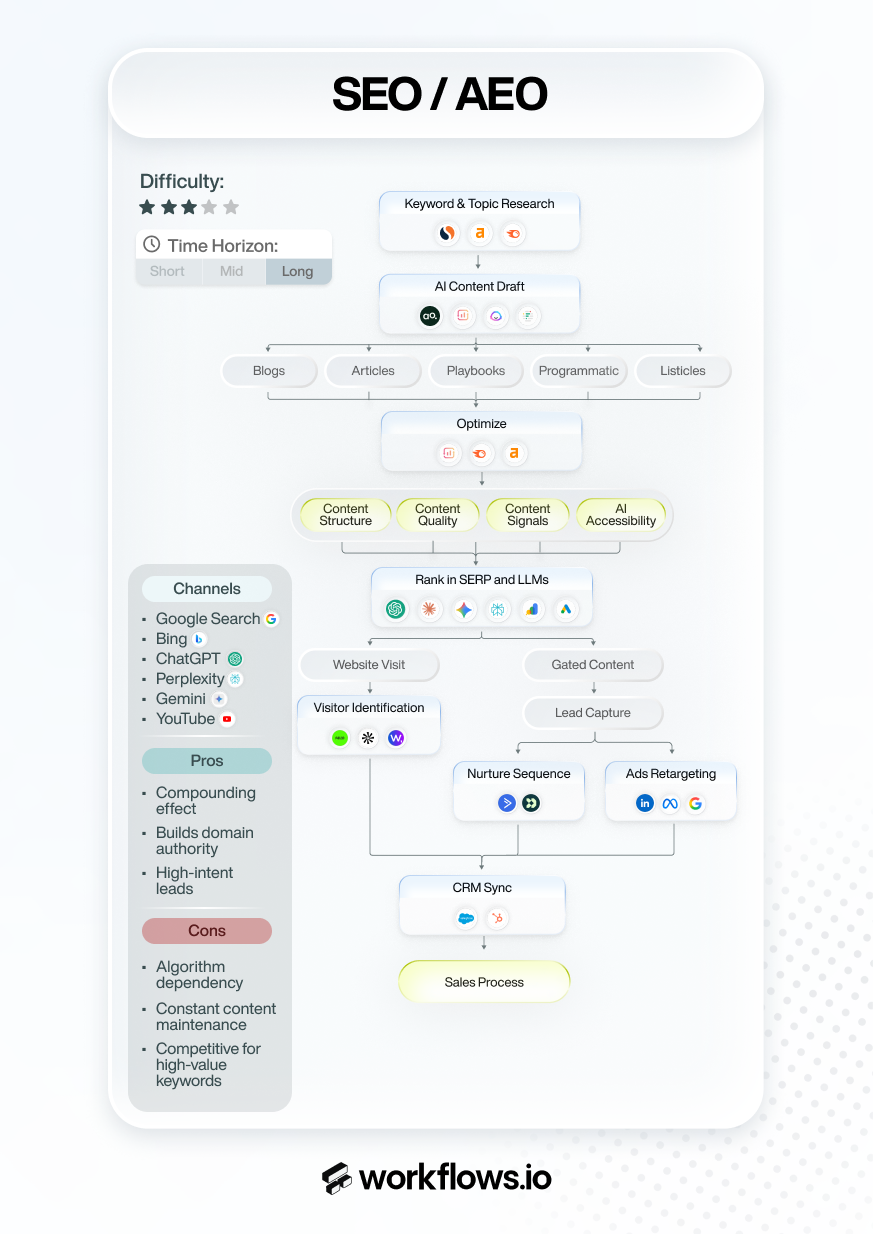
Stage 1: Keyword and topic research
You start with keyword and topic research.
Semrush, Ahrefs, and similar tools show what people are searching for and how competitive each term is. AEO-focused research also looks at what LLMs are answering, which often differs from what Google indexes.
Stage 2: AI content drafting
AI drafts the content.
Anthropic, AirOps, Claude, and Perplexity handle first drafts across five content types.
Blogs: Standard SEO articles.
Long-form articles: Deep guides and evergreen references.
Playbooks: How-to breakdowns of specific workflows.
Programmatic pages: Auto-generated at scale for long-tail terms.
Listicles: Rankings, comparisons, tool round-ups.
Human editing sits on top. AI drafts fast. Humans make it accurate and voice-consistent.
Stage 3: Optimisation
Optimisation covers four dimensions.
Content structure: Clean headings, scannable formatting, semantic hierarchy.
Content quality: Expertise, examples, depth.
Content signals: Backlinks, dwell time, social shares.
AI accessibility: Schema markup, question-answer formatting, structured data that LLMs can pull directly.
AEO is where structure and AI accessibility earn their keep. The pages that rank in ChatGPT and Perplexity are the ones formatted for AI extraction, not just human reading.
Stage 4: Ranking and traffic capture
The goal is to rank in both traditional SERPs (Google, Bing) and LLM answers (ChatGPT, Perplexity, Claude, Gemini).
The content that ranks in both drives compounding traffic. Google sends buyers still Googling. LLMs send buyers who've moved to chat-based search.
Stage 5: Lead capture and CRM sync
Two paths convert that traffic.
Website visits get identified via reverse-IP tools (RB2B, Warmly), then routed into nurture sequences and ads retargeting.
Gated content captures leads directly through forms.
Everything syncs to the CRM and feeds the sales process.
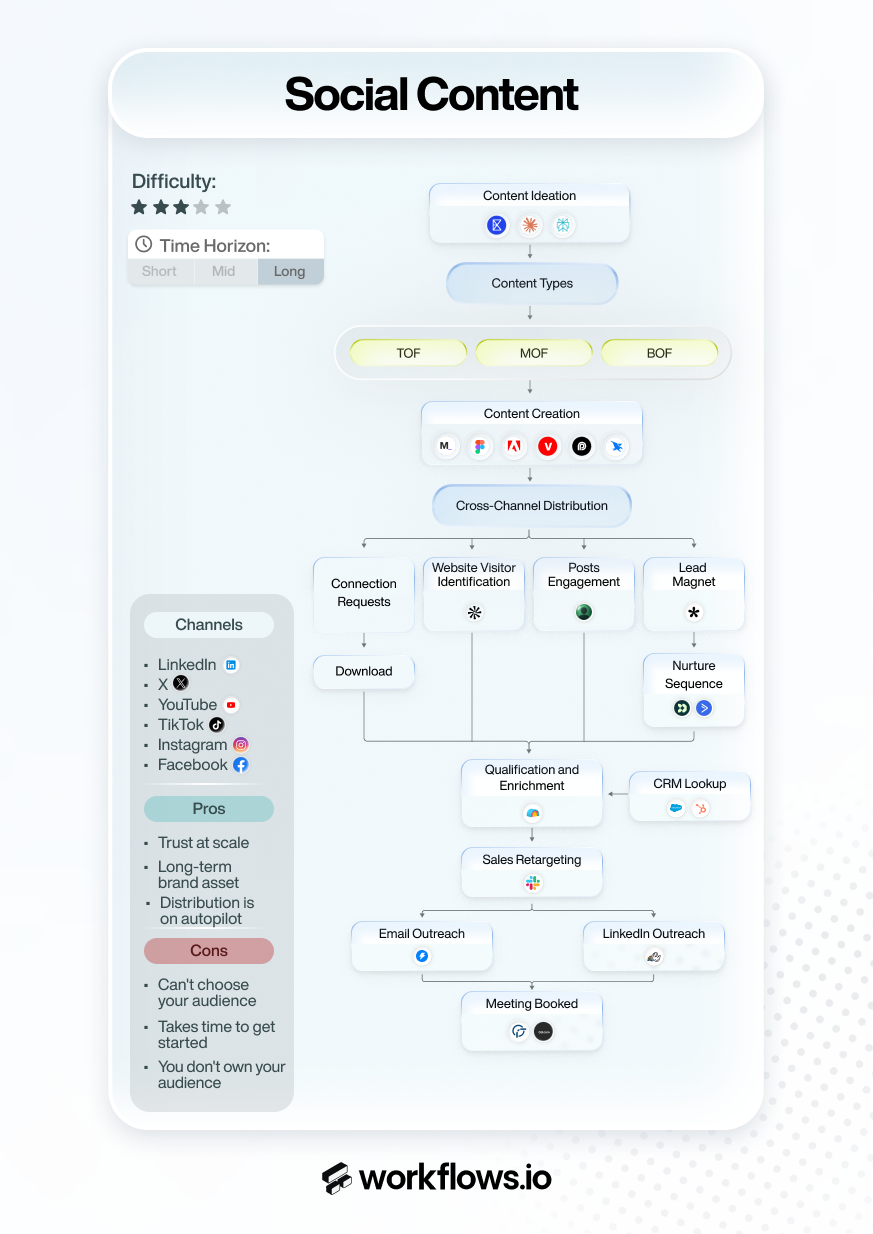
8. Social Content
Social content builds trust at scale on LinkedIn, YouTube, X, TikTok, Instagram, and Facebook.
The motion converts that trust when buyers are ready.
Stage 1: Content ideation
Content ideation starts the process.
ChatGPT, Claude, and Gemini help pull ideas from three sources.
Customer research: Interviews, calls, support tickets.
Product launches: New features, partnerships, milestones.
Industry news: Competitor moves, category shifts, market trends.
The best content sits at the intersection of all three.
Stage 2: Content creation
Content types split into three funnel stages.
TOF (top of funnel): Awareness content that pulls in new followers.
MOF (middle of funnel): Educational content that builds trust.
BOF (bottom of funnel): Conversion content that moves buyers to action.
Creation happens across the tool stack: writing tools for copy, design tools for visuals, video editors for short-form.
Stage 3: Cross-channel distribution
Every piece gets adapted for every platform it fits.
LinkedIn wants professional depth and long-form.
X wants short, sharp, and topical.
YouTube wants long-form video with strong hooks.
TikTok and Instagram want short-form video with high production polish.
The same idea gets remixed for each platform, not copy-pasted.
Stage 4: Activation and signal capture
The activation layer captures every interaction.
Connection requests on LinkedIn.
Website visitor identification through Jungler or RB2B.
Post engagement: Likes, comments, shares.
Lead magnet downloads: Gated PDFs, templates, calculators.
Each interaction becomes a signal. Downloads flow into nurture sequences. Engagers get qualified and enriched through Clay.
Stage 5: Sales retargeting
A CRM lookup checks if the person is already in the pipeline.
Sales retargeting kicks in for anyone who fits the ICP but hasn't been in contact. Email outreach and LinkedIn outreach run through the compounding effect of the audience already knowing your name.
Meetings get booked, either directly through Chili Piper or Ergo, or through the sales team following up.
Full breakdown in our complete LinkedIn growth guide.
9. Events
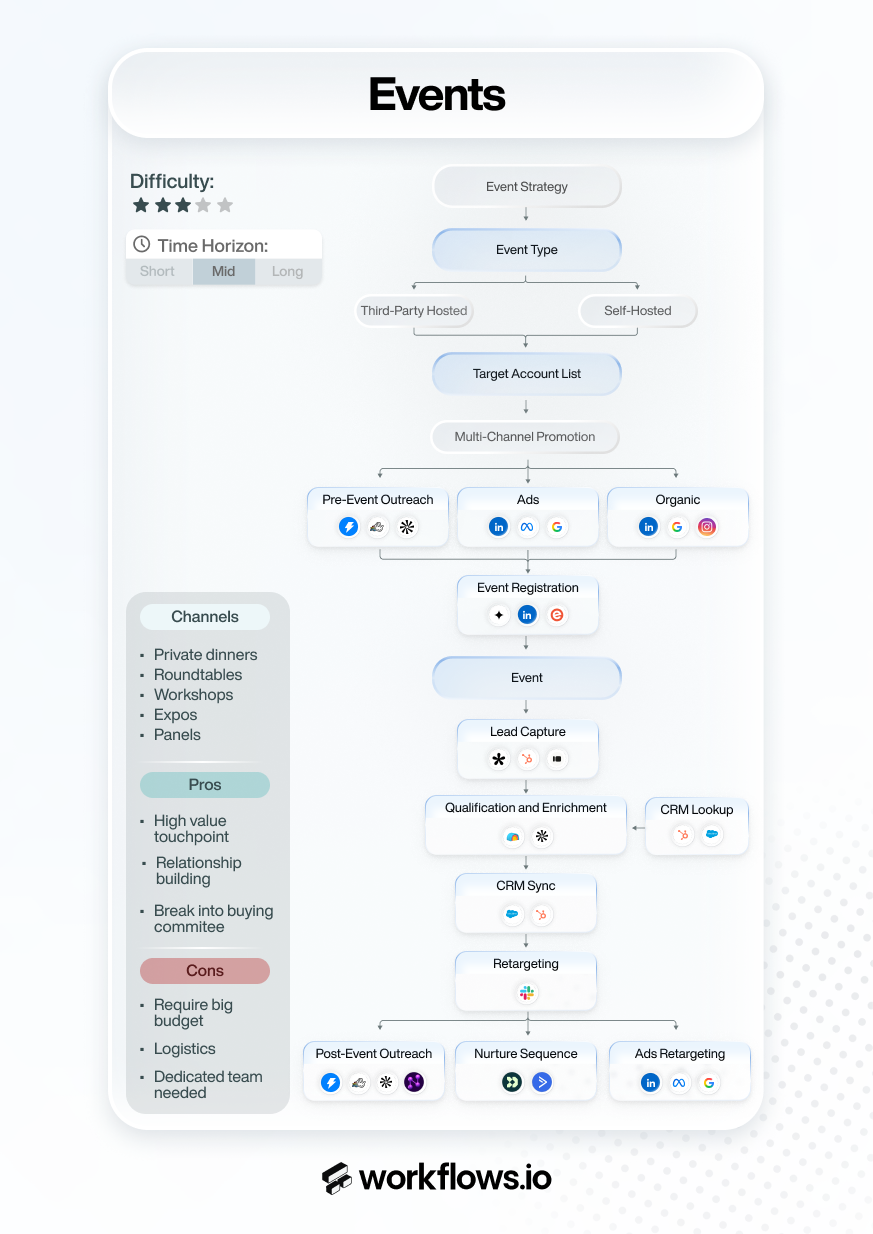
Events are the motion for high-trust, high-value relationships.
Private dinners, roundtables, workshops, expos, and panels put you in front of the buyers your other motions can't reach.
Stage 1: Event strategy
You start with event strategy. Which events fit your ICP? Which put the right buyers in the room?
Events split into two types.
Third-party hosted: Conferences, expos, summits. You're on someone else's stage.
Self-hosted: Dinners, roundtables, workshops. You're on your own.
Third-party events reach broader audiences but give you less control. Self-hosted events give you tighter control and better data but require more logistics.
Stage 2: Multi-channel promotion
A target account list drives promotion across three channels.
Pre-event outreach through Instantly, Ergo, and Clay warms the accounts you want to see there.
Ads on LinkedIn, Meta, and Google target the same list.
Organic content on LinkedIn, Google, and Instagram builds anticipation.
Registration happens through Luma, LinkedIn events, or Google Forms.
Stage 3: Event and lead capture
The event itself is the peak moment.
Lead capture happens through badge scans, business cards, or manual notes. Every attendee becomes a lead. Every conversation becomes a signal.
Stage 4: Qualification and CRM sync
Every lead runs through qualification and enrichment against the CRM.
A CRM lookup checks who's already in your pipeline. Enrichment fills in gaps for anyone new.
Every lead syncs to the CRM with the event as the source of contact.
Stage 5: Post-event follow-up
The follow-up sequence is where most events fail.
Retargeting keeps you top of mind through Slack alerts to reps.
Post-event outreach reaches out to every attendee within 48 hours.
Nurture sequences run for anyone not ready to book.
Ads retargeting keeps the brand in front of them for the next 90 days.
The best-run events treat the event as the middle of a 6-month workflow, not the finish line.
Frequently asked questions
What is a GTM motion?
A GTM motion is a repeatable system for generating pipeline and revenue. It combines a channel (email, LinkedIn, ads, events) with the surrounding infrastructure: ICP model, list, sequencing, routing, follow-up, and closing.How many GTM motions should a B2B company run?
Many B2B teams run one or two. The best-performing companies stack four or more, mixing short-horizon motions for immediate pipeline with long-horizon motions that compound over quarters.What's the difference between a GTM motion and a channel?
A channel is one place you reach buyers (LinkedIn, cold email, ads). A motion is the whole system around that channel: how you build the list, how you sequence outreach, how you route replies, and how you close.Which GTM motion has the lowest CAC?
Product-Led Growth typically has the lowest CAC at scale, followed by Community/Partner Led and SEO/AEO. All three take months to instrument, and all three compound over time.What is AEO?
AEO (Answer Engine Optimisation) is the practice of structuring content so LLM search engines like ChatGPT, Perplexity, Claude, and Gemini pull it into their answers. It's the LLM-era version of SEO and typically involves schema markup, question-answer formatting, and clean semantic structure.What is a PQL?
A PQL (product-qualified lead) is a user who has crossed a threshold in your product that signals buying intent. Common PQL triggers include seat threshold crossings, feature gate encounters, and usage limit hits.
Conclusion
Cold outbound, PLG, ABM, community, paid, SEO, social, and events aren't nine competing strategies. They're nine layers of the same B2B growth system.
The teams that grow the fastest don't pick one motion. They stack the ones that fit their ICP, budget, and time horizon, and they build the infrastructure that makes each motion talk to the others.
Getting all nine to work together isn't a marketing problem. It's an infrastructure problem, and it's the one we solve at workflows.io.
If you're figuring out which motions to stack for your business, or how to build the systems that run them, book a strategy call with our team. We'll walk through where you are today, which motions will produce the fastest lift, and what it would take to build them for your team.